This man is party to a legally binding contract that he and the other party are trying to execute without interference:
Brendon Ayanbadejo
This man is interfering with the smooth and peaceful execution of that contract:
Emmett C. Burns, Jr.
If an activist uses his activism to interfere with the machinations of commerce, I believe it is a sin that conservatives would condemn. When two millionaires have agreements, and are happily and successfully conducting legitimate business, Mitt Romney, Rush Limbaugh, Michelle Bachmann, Sarah Palin, Ann Coulter and their allies should be on the airwaves condemning any "socialist" who is interfering with good, old-fashioned, American, God-given commerce.
There is a minister in Maryland interfering with the execution of a contract between Brendon Ayanbadejo and Steve Bisciotti. This minister believes that Bisciotti should interfere with Ayanbadejo's constitutional rights.
If one party to a contract tries to abridge the constitutional rights of the other party in the contract, it would not be good for the contractual obligations of the parties, their ability to generate profit, and their right to live in pursuit of happiness.
This seems like a bandwagon and script that the Republican presidential hopeful had created himself! What could be better? A black guy in Maryland interfering in the legitimate business agreement between two millionaires.
Ann Coulter should buy a brand new black cocktail dress for some morning television appearances to point out that a Democrat Socialist is at it again! Trying to destroy America.
Sarah Palin should be explaining that the lamestream media and Justice Department is failing to come to the defense of good American businessmen!
Rush Limbaugh should be apoplectic, while Glenn Beck weeps.
Let's frame it this way: Barney Frank writes to Roger Ailes and demands that Ailes stop Geraldo Rivera from reporting on the Democratic Convention. I think the airwaves would be filthy with opinions from the conservatives.
If I remember correctly, American conservatism is currently basing its movement on the notion that nothing trumps commerce. No worker rights, no civil rights, no government regulation, no taxation structure, nothing, ever.
To interfere with commerce is an egregious sin.
So, I am not certain why conservatives have failed to defend the rights of Bisciotti and Ayanbedejo to conduct legal business, and execute their contract in peace, without interference from somebody in power.
In this case, it is A-OK with the conservatives to interfere with the peaceful execution of a contract. Why? Because the minister interfering with commerce is demanding that the parties to the contract stop expressing opinions about social issues; specifically, same-sex marriage. So, again, we see that conservatives only care about commerce and constitutional issues when it's convenient for them; they do not actually believe that commerce and constitutionality should be protected for everybody. They believe that their commerce and their constitutional rights should be defended and protected; but not anyone with whom they disagree.
In the vacuum created by the deafening silence of right-wing media, pundits, politicians, and elected officials, another businessman in the same industry as Bisciotti and Ayanbadejo has decided to defend them, and admonish the minister for impinging on the constitutional rights of the parties.
Still the right-wing, with all their demands that nobody interfere with commerce, remain silent.
Then the minister claims that although he tried to interfere with the constitutional rights of the businessmen, he has first amendment rights, too.
Yes, Reverend, you do have first amendment protection, the right to express your hate and intolerance. Not one single person has ever tried to abridge that right, or silence you.
On the other hand, you wrote a letter suggesting that an employer abridge the first amendment rights of his employees. I am certain this would be a violation of their contract.
So, when that minister says he has first amendment rights, too, it is a red herring. He is just making-up stuff to deflect the negative publicity that a bigoted pig deserves.
In reality, he is exactly the type of person that I want to see execute his first amendment right to free speech, because it highlights the idiocy of his hatred.
Because he drapes his hate and bigotry in the vestments of a church doesn't make him any less hateful or bigoted.
Just because he pays his mortgage by reading Bible verses doesn't mean he is immune from criticism, especially when he tries to abridge the constitutional rights of an American citizen.
So, yes, Reverend Burns, we all agree that you have the constitutional right to spew your bigoted filth; but I am not certain you have a constitutional right to interfere with commerce, to insert yourself into the negotiations of millionaires, or to abridge the constitutional rights of another.
And where is Ann Coulter and where is Paul Ryan and where is Karl Rove when a minister interferes with commerce?
What is more important to them: commerce or christianity?
I guess it isn't commerce.
So, the next time a conservative wants to run-off at the mouth about commerce and constitutional rights, just laugh in his face, tell him he's a hypocrite, and walk away.
Conservatives don't care about commerce or the Constitution, they care only about themselves.
On Sunday, I was still receiving emails imploring me to attend the Black Friday sales here and there. Last time I looked, Sunday was not Friday.
Yesterday I was invited to online Cyber-Monday sales.
The numbers aren't in yet for Cyber-Monday; but, Black Friday numbers sent the stock market surging on Monday.
Thank you shoppers, I was finally able to dump that Lowe's stock when my holding went from deep in the red to a lovely green color! So Christmas-y!
On Black Friday (weekend), shoppers spent $52,000,000,000 this year. Last year we spent a paltry $45,000,000,000.
It took 226,000,000 people to spend that fifty-two billion (an average of $230 per shopper). Last year, only 212,000,000 people spent that forty-five billion (an average of $212 per shopper).
Who were these people and what did they buy?
It started as all public gatherings seem to start today. A bunch of middle-class white people showed up with tents and chairs and sleeping bags, and occupied unused space in public late at night. Coast-to-coast they established local sites all joined in solidarity to one end: They were staking their Constitutional right to shop. The police came to investigate.
Unlike other recent encampments of Americas exercising their Constitutional rights, no pepper-spray or billy clubs were used on these unholy thugs. After all, they weren't claiming a right to free speech or peaceable assembly - they were claiming something much more important and more in-line with the founding fathers' intentions: the right to spend money!
And the right to push and shove each other.
And to climb over each other's dead bodies to save God's capitalism.
There was a pepper-spraying mama who won the right to purchase an X-box 360 when she won a competitive shopping bout at Target. In another store, an elderly man lay dead in the aisles while bargain-hunters stepped over and around him without regard for any need to assist him. Youngsters were trampled.
It was pretty gruesome.
And these incidents didn't take place at good stores with valuable merchandise. This stuff happened at crappy places like Target and Wal-Mart over things like televisions!
So now that the Bush-appointed Federal District Court Judge has chimed in with his opinion that the Patient Protection and Affordable Care Act is unconstitutional, it seems like a good time to review some of the basic popular arguments for and against healthcare reform as it stands.
Briefly, we have heard - and Congress agreed - that we cannot have tax-payer supported universal healthcare coverage in the United States because that would amount to socialism. As a result, rather than reforming healthcare costs and cost-drivers, what Congress ended up enacting was a bill that the President signed, mandating that everyone must eventually buy into the completely capitalistic system of contracting with profit-driven health INSURANCE companies.
Now back up a second. What is the basic idea underlying capitalist health insurance? It is to collect and maintain a large reservoir of funds by having a large number of people contribute relatively small amounts of money, on a regular basis over time, into health insurance accounts controlled by capitalist corporations, most of which are euphemistically called Health Management Organizations (HMOs). This system is feasible and necessary in our capitalist economy because only a very few of us could possibly bear the financial burden of getting sick or injured and having to engage with the bloated profit-driven US medical industry, without going bankrupt every time we felt a pain or physical discomfort.
So, all subscribers pay in to those accounts which theoretically make funds available to each one when he or she gets sick or injured and needs to pay for their always-catastrophic medical expenses. These pools of money are supposed to become capital resources, which are presumedly only made available to the minority who are sick or hurt at any given time. All subscribers pay into the pool and continue to pay regularly through their time of illness and after their recovery, ad perpetuum. Whether sick or well, you never stop paying into the system that provides tons of money - unused for medical care at any given time - to the private controlling interests who primarily use the excess funds to pay their top brass outrageous salaries & bonuses and leave plenty to invest in other capitalist corporate ventures.
Universal healthcare would have provided for a tax-supported system of paying for health care that would operate according to the same basic idea as health insurance - spreading medical costs across the widest number of contributors - all US taxpayers - but it would be a radically different system than the capitalist model in that it would naturally eliminate, for one thing, the HMO & Insurance Company profit motive that insures bloated costs and removes most incentives to promote health over illness. And it would mean that the contributions to health insurance that each of us would make, could be equitably distributed, potentially reducing the individual burden we all bear to the absolute lowest possible. This is the (shudder) socialist system that was taken off the table early on in the process of formulating "healthcare reform." But it is not this type of system that was ruled unconstitutional in the Federal District Court.
What was ruled unconstitutional was the idea that our representative, elected government could legislate a requirement that capitalist, profit-driven insurance companies would have to spread the cost of subscribing to health insurance to everyone. In doing so they would accomplish the (quiver) socialist agenda item of minimizing individual costs for health insurance coverage for all of us. This is framed as a matter of infringing on our individual right to decline health insurance coverage altogether -- which we should be able to do as a free people. If we are a freedom-loving citizenry, the argument goes, how can our government force us to pay for any "product" on the free market if we individually decide that we do not want it?
Skipping over many of the inherent absurdities of this situation -- including the argument about whether insurance is a "product" or not (a product you never really get to own, sell, exchange or get any reasonable return on) -- what effect does all this have on the concept of "socialist" vs "capitalist" or "free market" spending decisions when it comes to paying the costs of healthcare?
For one thing, it may be argued that requiring everyone to subscribe to health insurance implies a certain loss of competition and control over price-fixing by insurance company moguls. Being less able to justify gouging us with outrageous rates & premiums companies would instead be compelled to undercut each others' prices to garner the greatest market share in order to stay profitable. If everyone were legally bound to find a policy that they could afford it would shift the whole paradigm around to make insurance largely a buyer's market.
But, sticking with the status quo rather than mandating that everyone subscribe to some kind of health insurance, we all still end up needing medical care at some point and it will have to be paid for somehow. So those who opt out of the insurance game will either be faced with unbearable out-of-pocket costs or they will, as now, have to rely on the limited, inferior care provided by way of public assistance, welfare, medicaid/medicare system or some other TAXPAYER-SUPPORTED system.
Doesn't that mean that all of us freedom-loving taxpayers end up paying for the healthcare of others anyway? If so, then the status quo means capitalist healthcare for those who can barely afford it (for the most part) and socialist healthcare for those who can't pay for it themselves.
Of all the disingenuous arguments we have heard against healthcare reform or even health insurance reform, then, the idea it may be unconstitutional to mandate coverage for everyone, the most insidious is this idea that our "freedom" is somehow compromised by the Patient Protection and Affordable Care Act. The politicians and their cronies who oppose this provision of the bill on the grounds they claim are unconstitutional should have the balls and integrity to put forth an alternative bill that would accomplish what will happen by repealing the mandatory coverage provision while totally dismissing universal healthcare.
That is: anyone who wishes to opt out of insurance coverage should have the absolute freedom to do so. But in the name of pure-bred free-market capitalism they will either have to pay the full cost of any medical care they may need or forego medical care altogether. No exceptions.
If universal healthcare is unconstitutional by one means or another then NO taxpayer-supported healthcare should be available to anyone. That would, of course, extend to old people, the indigent and government employees - even military personnel and veterans, judges and all elected officials. Especially members of Congress. Our taxes pay their salaries and benefits, why should we be paying for their healthcare coverage as well as our own?
Fly that up your pseudo-patriotic flag pole and see who salutes!
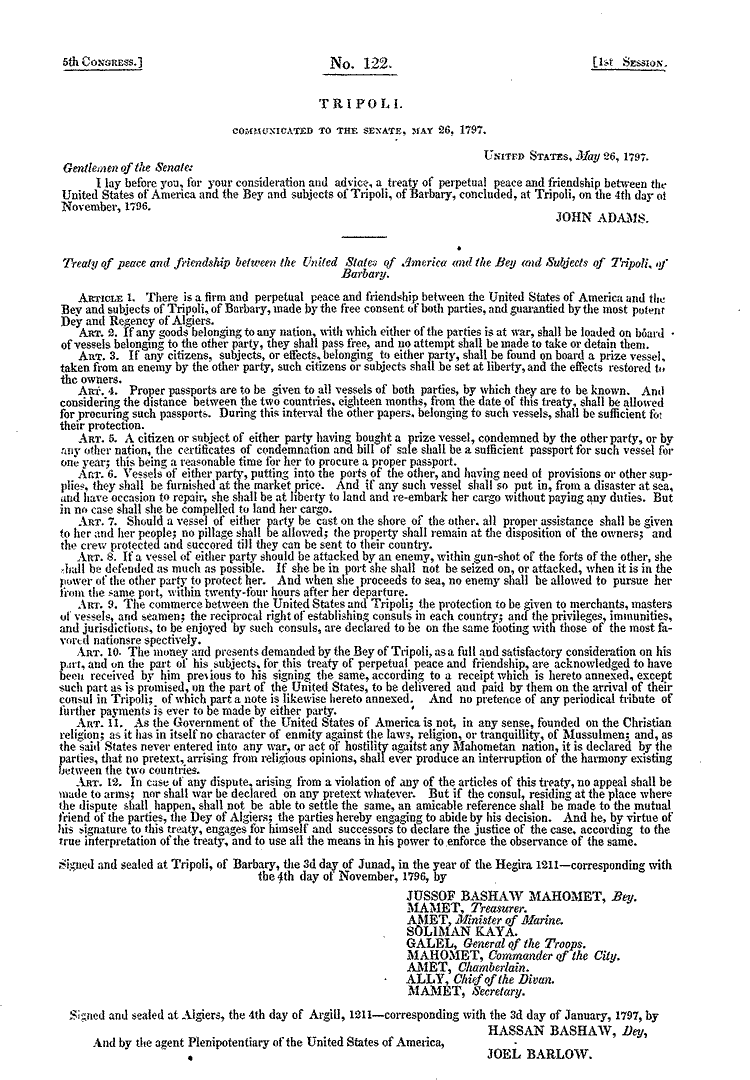
Continuing with my thoughts of yesterday when I confirmed that God is not mentioned in the Constitution or the Bill of Rights and Other Amendments, I have learned that there is a legal document, ratified by Congress and President John Adams (perhaps the most parochial and religious of all the founding fathers) in 1796, stating that the United States is specifically NOT a Christian nation.
That's right: not a Christian nation! John Adams ratified a treaty that states the United States is not a Christian nation.
Let me say that one more time for you: The Fifth Congress of the United States, and President John Adams, in 1796 signed a treaty that declares, in black & white, that the United States is not a Christian nation.
Art. 11. As the Government of the United States of America is not, in any sense, founded on the Christian religion; as it has in itself no character of enmity against the laws, religion, or tranquillity, of Mussulmen; and, as the said States never entered into any war, or act of hostility against any Mahometan nation, it is declared by the parties, that no pretext arising from religious opinions, shall ever produce an interruption of the harmony existing between the two countries.
Wow! So that's pretty explicit: " . . . the United States of America is not, in any sense, founded on the Christian religion . . . ."
So, everyone repeat after me: "The United States is not a Christian nation."
I am adding this tidbit of information to the fact that neither the United States Constitution nor the Bill of Rights and Other Amendments include any mention of God to the points that help me conclude that my country is intended to be a utopia that allows religious and non-religious people alike to exist as a society. Furthermore, I believe the founding fathers intended to protect all citizens from the finagling of the religious to insert their religiosity into the public (governmental) discourse.
Tomorrow, I think I'll discuss Article VI, Section 3 of the Constitution, which ensures there can be no religious test to hold public office.
I love being an American, and I love being a Christian, and I like them really separate from each other. It's just so much more . . . how do you say . . . civilized!
No! Nobody's God or god is in the documents that define the United States of America. So, next time anyone tells you that the USA is a Christian nation, just tell them they are wrong and direct them to the "Constitution of the United States" and "Bill of Rights and Later Amendments."
We the People of the United States, in Order to form a more perfect Union, establish Justice, insure domestic Tranquility, provide for the common defence, promote the general Welfare, and secure the Blessings of Liberty to ourselves and our Posterity, do ordain and establish this Constitution for the United States of America.
Article I
Section 1. All legislative Powers herein granted shall be vested in a Congress of the United States, which shall consist of a Senate and House of Representatives.
Section 2. The House of Representatives shall be composed of Members chosen every second Year by the People of the several States, and the Electors in each State shall have the Qualifications requisite for Electors of the most numerous Branch of the State Legislature.
No Person shall be a Representative who shall not have attained to the age of twenty five Years, and been seven Years a Citizen of the United States, and who shall not, when elected, be an Inhabitant of that State in which he shall be chosen.
Representatives and direct Taxes shall be apportioned among the several States which may be included within this Union, according to their respective Numbers, which shall be determined by adding to the whole Number of free Persons, including those bound to Service for a Term of Years, and excluding Indians not taxed, three fifths of all other Persons. The actual Enumeration shall be made within three Years after the first Meeting of the Congress of the United States, and within every subsequent Term of ten Years, in such Manner as they shall by Law direct. The Number of Representatives shall not exceed one for every thirty Thousand, but each State shall have at Least one Representative; and until such enumeration shall be made, the State of New Hampshire shall be entitled to chuse three, Massachusetts eight, Rhode-Island and Providence Plantations one, Connecticut five, New-York six, New Jersey four, Pennsylvania eight, Delaware one, Maryland six, Virginia ten, North Carolina five, South Carolina five, and Georgia three.
When vacancies happen in the Representation from any State, the Executive Authority thereof shall issue Writs of Election to fill such Vacancies.
The House of Representatives shall chuse their Speaker and other Officers; and shall have the sole Power of Impeachment.
Section 3. The Senate of the United States shall be composed of two Senators from each State, chosen by the Legislature thereof, for six Years; and each Senator shall have one Vote.
Immediately after they shall be assembled in Consequence of the first Election, they shall be divided as equally as may be into three Classes. The Seats of the Senators of the first Class shall be vacated at the Expiration of the second Year, of the second Class at the Expiration of the fourth Year, and the third Class at the Expiration of the sixth Year, so that one third may be chosen every second Year; and if Vacancies happen by Resignation, or otherwise, during the Recess of the Legislature of any State, the Executive thereof may make temporary Appointments until the next Meeting of the Legislature, which shall then fill such Vacancies.
No Person shall be a Senator who shall not have attained to the Age of thirty Years, and been nine Years a Citizen of the United States and who shall not, when elected, be an Inhabitant of that State for which he shall be chosen.
The Vice President of the United States shall be President of the Senate, but shall have no Vote, unless they be equally divided.
The Senate shall chuse their other Officers, and also a President pro tempore, in the Absence of the Vice President, or when he shall exercise the Office of President of the United States.
The Senate shall have the sole Power to try all Impeachments. When sitting for that Purpose, they shall be on Oath or Affirmation. When the President of the United States is tried, the Chief Justice shall preside: And no Person shall be convicted without the Concurrence of two thirds of the Members present.
Judgment in Cases of Impeachment shall not extend further than to removal from Office, and disqualification to hold and enjoy any Office of Honor, Trust or Profit under the United States: but the Party convicted shall nevertheless be liable and subject to Indictment, Trial, Judgment and Punishment, according to Law.
Section 4. The Times, Places and Manner of holding Elections for Senators and Representatives, shall be prescribed in each State by the Legislature thereof; but the Congress may at any time by Law make or alter such Regulations, except as to the Places of chusing Senators.
The Congress shall assemble at least once in every Year, and such Meeting shall be on the first Monday in December, unless they shall by Law appoint a different Day.
Section 5. Each House shall be the Judge of the Elections, Returns and Qualifications of its own Members, and a Majority of each shall constitute a Quorum to do Business; but a smaller Number may adjourn from day to day, and may be authorized to compel the Attendance of absent Members, in such Manner, and under such Penalties as each House may provide.
Each House may determine the Rules of its Proceedings, punish its Members for disorderly Behaviour, and, with the Concurrence of two thirds, expel a Member.
Each House shall keep a Journal of its Proceedings, and from time to time publish the same, excepting such Parts as may in their Judgment require Secrecy; and the Yeas and Nays of the Members of either House on any question shall, at the Desire of one fifth of those Present, be entered on the Journal.
Neither House, during the Session of Congress, shall, without the Consent of the other, adjourn for more than three days, nor to any other Place than that in which the two Houses shall be sitting.
Section 6. The Senators and Representatives shall receive a Compensation for their Services, to be ascertained by Law, and paid out of the Treasury of the United States. They shall in all Cases, except Treason, Felony and Breach of the Peace, be privileged from Arrest during their Attendance at the Session of their respective Houses, and in going to and returning from the same; and for any Speech or Debate in either House, they shall not be questioned in any other Place.
No Senator or Representative shall, during the Time for which he was elected, be appointed to any civil Office under the Authority of the United States, which shall have been created, or the Emoluments whereof shall have been encreased during such time: and no Person holding any Office under the United States, shall be a Member of either House during his Continuance in Office.
Section 7. All Bills for raising Revenue shall originate in the House of Representatives; but the Senate may propose or concur with Amendments as on other Bills.
Every Bill which shall have passed the House of Representatives and the Senate, shall, before it become a Law, be presented to the President of the United States; if he approve he shall sign it, but if not he shall return it, with his Objections to that House in which it shall have originated, who shall enter the Objections at large on their Journal, and proceed to reconsider it. If after such Reconsideration two thirds of that House shall agree to pass the Bill, it shall be sent, together with the Objections, to the other House, by which it shall likewise be reconsidered, and if approved by two thirds of that House, it shall become a Law. But in all such Cases the Votes of both Houses shall be determined by Yeas and Nays, and the Names of the Persons voting for and against the Bill shall be entered on the Journal of each House respectively. If any Bill shall not be returned by the President within ten Days (Sundays excepted) after it shall have been presented to him, the Same shall be a Law, in like Manner as if he had signed it, unless the Congress by their Adjournment prevent its Return, in which Case it shall not be a Law.
Every Order, Resolution, or Vote to which the Concurrence of the Senate and House of Representatives may be necessary (except on a question of Adjournment) shall be presented to the President of the United States; and before the Same shall take Effect, shall be approved by him, or being disapproved by him, shall be repassed by two thirds of the Senate and House of Representatives, according to the Rules and Limitations prescribed in the Case of a Bill.
Section 8. The Congress shall have Power To lay and collect Taxes, Duties, Imposts and Excises, to pay the Debts and provide for the common Defence and general Welfare of the United States; but all Duties, Imposts and Excises shall be uniform throughout the United States;
To borrow Money on the credit of the United States;
To regulate Commerce with foreign Nations, and among the several States, and with the Indian Tribes;
To establish an uniform Rule of Naturalization, and uniform Laws on the subject of Bankruptcies throughout the United States;
To coin Money, regulate the Value thereof, and of foreign Coin, and fix the Standard of Weights and Measures;
To provide for the Punishment of counterfeiting the Securities and current Coin of the United States;
To establish Post Offices and post Roads;
To promote the Progress of Science and useful Arts, by securing for limited Times to Authors and Inventors the exclusive Right to their respective Writings and Discoveries;
To constitute Tribunals inferior to the supreme Court;
To define and punish Piracies and Felonies committed on the high Seas, and Offences against the Law of Nations;
To declare War, grant Letters of Marque and Reprisal, and make Rules concerning Captures on Land and Water;
To raise and support Armies, but no Appropriation of Money to that Use shall be for a longer Term than two Years;
To provide and maintain a Navy;
To make Rules for the Government and Regulation of the land and naval Forces;
To provide for calling forth the Militia to execute the Laws of the Union, suppress Insurrections and repel Invasions;
To provide for organizing, arming, and disciplining, the Militia, and for governing such Part of them as may be employed in the Service of the United States, reserving to the States respectively, the Appointment of the Officers, and the Authority of training the Militia according to the discipline prescribed by Congress;
To exercise exclusive Legislation in all Cases whatsoever, over such District (not exceeding ten Miles square) as may, by Cession of particular States, and the Acceptance of Congress, become the Seat of the Government of the United States, and to exercise like Authority over all Places purchased by the Consent of the Legislature of the State in which the Same shall be, for the Erection of Forts, Magazines, Arsenals, dock-Yards, and other needful Buildings;--And
To make all Laws which shall be necessary and proper for carrying into Execution the foregoing Powers, and all other Powers vested by this Constitution in the Government of the United States, or in any Department or Officer thereof.
Section 9. The Migration or Importation of such Persons as any of the States now existing shall think proper to admit, shall not be prohibited by the Congress prior to the Year one thousand eight hundred and eight, but a Tax or duty may be imposed on such Importation, not exceeding ten dollars for each Person.
The Privilege of the Writ of Habeas Corpus shall not be suspended, unless when in Cases of Rebellion or Invasion the public Safety may require it.
No Bill of Attainder or ex post facto Law shall be passed.
No Capitation, or other direct, Tax shall be laid, unless in Proportion to the Census or Enumeration herein before directed to be taken.
No Tax or Duty shall be laid on Articles exported from any State.
No Preference shall be given by any Regulation of Commerce or Revenue to the Ports of one State over those of another: nor shall Vessels bound to, or from, one State, be obliged to enter, clear or pay Duties in another.
No Money shall be drawn from the Treasury, but in Consequence of Appropriations made by Law; and a regular Statement and Account of Receipts and Expenditures of all public Money shall be published from time to time.
No Title of Nobility shall be granted by the United States: And no Person holding any Office of Profit or Trust under them, shall, without the Consent of the Congress, accept of any present, Emolument, Office, or Title, of any kind whatever, from any King, Prince, or foreign State.
Section 10. No State shall enter into any Treaty, Alliance, or Confederation; grant Letters of Marque and Reprisal; coin Money; emit Bills of Credit; make any Thing but gold and silver Coin a Tender in Payment of Debts; pass any Bill of Attainder, ex post facto Law, or Law impairing the Obligation of Contracts, or grant any Title of Nobility.
No State shall, without the Consent of the Congress, lay any Imposts or Duties on Imports or Exports, except what may be absolutely necessary for executing it's inspection Laws: and the net Produce of all Duties and Imposts, laid by any State on Imports or Exports, shall be for the Use of the Treasury of the United States; and all such Laws shall be subject to the Revision and Controul of the Congress.
No State shall, without the Consent of Congress, lay any Duty of Tonnage, keep Troops, or Ships of War in time of Peace, enter into any Agreement or Compact with another State, or with a foreign Power, or engage in War, unless actually invaded, or in such imminent Danger as will not admit of delay.
Article II
Section 1. The executive Power shall be vested in a President of the United States of America. He shall hold his Office during the Term of four Years, and, together with the Vice President, chosen for the same Term, be elected, as follows:
Each State shall appoint, in such Manner as the Legislature thereof may direct, a Number of Electors, equal to the whole Number of Senators and Representatives to which the State may be entitled in the Congress: but no Senator or Representative, or Person holding an Office of Trust or Profit under the United States, shall be appointed an Elector.
The Electors shall meet in their respective States, and vote by Ballot for two Persons, of whom one at least shall not be an Inhabitant of the same State with themselves. And they shall make a List of all the Persons voted for, and of the Number of Votes for each; which List they shall sign and certify, and transmit sealed to the Seat of the Government of the United States, directed to the President of the Senate. The President of the Senate shall, in the Presence of the Senate and House of Representatives, open all the Certificates, and the Votes shall then be counted. The Person having the greatest Number of Votes shall be the President, if such Number be a Majority of the whole Number of Electors appointed; and if there be more than one who have such Majority, and have an equal Number of Votes, then the House of Representatives shall immediately chuse by Ballot one of them for President; and if no Person have a Majority, then from the five highest on the List the said House shall in like Manner chuse the President. But in chusing the President, the Votes shall be taken by States, the Representation from each State having one Vote; A quorum for this Purpose shall consist of a Member or Members from two thirds of the States, and a Majority of all the States shall be necessary to a Choice. In every Case, after the Choice of the President, the Person having the greatest Number of Votes of the Electors shall be the Vice President. But if there should remain two or more who have equal Votes, the Senate shall chuse from them by Ballot the Vice President.
The Congress may determine the Time of chusing the Electors, and the Day on which they shall give their Votes; which Day shall be the same throughout the United States.
No Person except a natural born Citizen, or a Citizen of the United States, at the time of the Adoption of this Constitution, shall be eligible to the Office of President; neither shall any Person be eligible to that Office who shall not have attained to the Age of thirty five Years, and been fourteen Years a Resident within the United States.
In Case of the Removal of the President from Office, or of his Death, Resignation, or Inability to discharge the Powers and Duties of the said Office, the Same shall devolve on the Vice President, and the Congress may by Law provide for the Case of Removal, Death, Resignation or Inability, both of the President and Vice President, declaring what Officer shall then act as President, and such Officer shall act accordingly, until the Disability be removed, or a President shall be elected.
The President shall, at stated Times, receive for his Services, a Compensation, which shall neither be encreased nor diminished during the Period for which he shall have been elected, and he shall not receive within that Period any other Emolument from the United States, or any of them.
Before he enter on the Execution of his Office, he shall take the following Oath or Affirmation:--"I do solemnly swear (or affirm) that I will faithfully execute the Office of President of the United States, and will to the best of my Ability, preserve, protect and defend the Constitution of the United States."
Section 2. The President shall be Commander in Chief of the Army and Navy of the United States, and of the Militia of the several States, when called into the actual Service of the United States; he may require the Opinion, in writing, of the principal Officer in each of the executive Departments, upon any Subject relating to the Duties of their respective Offices, and he shall have Power to grant Reprieves and Pardons for Offences against the United States, except in Cases of Impeachment.
He shall have Power, by and with the Advice and Consent of the Senate, to make Treaties, provided two thirds of the Senators present concur; and he shall nominate, and by and with the Advice and Consent of the Senate, shall appoint Ambassadors, other public Ministers and Consuls, Judges of the supreme Court, and all other Officers of the United States, whose Appointments are not herein otherwise provided for, and which shall be established by Law: but the Congress may by Law vest the Appointment of such inferior Officers, as they think proper, in the President alone, in the Courts of Law, or in the Heads of Departments.
The President shall have Power to fill up all Vacancies that may happen during the Recess of the Senate, by granting Commissions which shall expire at the End of their next Session.
Section 3. He shall from time to time give to the Congress Information of the State of the Union, and recommend to their Consideration such Measures as he shall judge necessary and expedient; he may, on extraordinary Occasions, convene both Houses, or either of them, and in Case of Disagreement between them, with Respect to the Time of Adjournment, he may adjourn them to such Time as he shall think proper; he shall receive Ambassadors and other public Ministers; he shall take Care that the Laws be faithfully executed, and shall Commission all the Officers of the United States.
Section 4. The President, Vice President and all civil Officers of the United States, shall be removed from Office on Impeachment for, and Conviction of, Treason, Bribery, or other high Crimes and Misdemeanors.
Article III
Section 1. The judicial Power of the United States, shall be vested in one supreme Court, and in such inferior Courts as the Congress may from time to time ordain and establish. The Judges, both of the supreme and inferior Courts, shall hold their Offices during good Behaviour, and shall, at stated Times, receive for their Services, a Compensation, which shall not be diminished during their Continuance in Office.
Section 2. The judicial Power shall extend to all Cases, in Law and Equity, arising under this Constitution, the Laws of the United States, and Treaties made, or which shall be made, under their Authority;--to all Cases affecting Ambassadors, other public Ministers and Consuls;--to all Cases of admiralty and maritime Jurisdiction;--to Controversies to which the United States shall be a Party;--to Controversies between two or more States;--between a State and Citizens of another State;--between Citizens of different States;--between Citizens of the same State claiming Lands under Grants of different States, and between a State, or the Citizens thereof, and foreign States, Citizens or Subjects.
In all Cases affecting Ambassadors, other public Ministers and Consuls, and those in which a State shall be Party, the supreme Court shall have original Jurisdiction. In all the other Cases before mentioned, the supreme Court shall have appellate Jurisdiction, both as to Law and Fact, with such Exceptions, and under such Regulations as the Congress shall make.
The Trial of all Crimes, except in Cases of Impeachment, shall be by Jury; and such Trial shall be held in the State where the said Crimes shall have been committed; but when not committed within any State, the Trial shall be at such Place or Places as the Congress may by Law have directed.
Section 3. Treason against the United States, shall consist only in levying War against them, or in adhering to their Enemies, giving them Aid and Comfort. No Person shall be convicted of Treason unless on the Testimony of two Witnesses to the same overt Act, or on Confession in open Court.
The Congress shall have Power to declare the Punishment of Treason, but no Attainder of Treason shall work Corruption of Blood, or Forfeiture except during the Life of the Person attainted.
Article IV
Section 1. Full Faith and Credit shall be given in each State to the public Acts, Records, and judicial Proceedings of every other State. And the Congress may by general Laws prescribe the Manner in which such Acts, Records, and Proceedings shall be proved, and the Effect thereof.
Section 2. The Citizens of each State shall be entitled to all Privileges and Immunities of Citizens in the several States.
A Person charged in any State with Treason, Felony, or other Crime, who shall flee from Justice, and be found in another State, shall on Demand of the executive Authority of the State from which he fled, be delivered up, to be removed to the State having Jurisdiction of the Crime.
No Person held to Service or Labour in one State, under the Laws thereof, escaping into another, shall, in Consequence of any Law or Regulation therein, be discharged from such Service or Labour, but shall be delivered up on Claim of the Party to whom such Service or Labour may be due.
Section 3. New States may be admitted by the Congress into this Union; but no new States shall be formed or erected within the Jurisdiction of any other State; nor any State be formed by the Junction of two or more States, or Parts of States, without the Consent of the Legislatures of the States concerned as well as of the Congress.
The Congress shall have Power to dispose of and make all needful Rules and Regulations respecting the Territory or other Property belonging to the United States; and nothing in this Constitution shall be so construed as to Prejudice any Claims of the United States, or of any particular State.
Section 4. The United States shall guarantee to every State in this Union a Republican Form of Government, and shall protect each of them against Invasion; and on Application of the Legislature, or of the Executive (when the Legislature cannot be convened) against domestic Violence.
Article V
The Congress, whenever two thirds of both Houses shall deem it necessary, shall propose Amendments to this Constitution, or, on the Application of the Legislatures of two thirds of the several States, shall call a Convention for proposing Amendments, which, in either Case, shall be valid to all Intents and Purposes, as Part of this Constitution, when ratified by the Legislatures of three fourths of the several States, or by Conventions in three fourths thereof, as the one or the other Mode of Ratification may be proposed by the Congress; Provided that no Amendment which may be made prior to the Year One thousand eight hundred and eight shall in any Manner affect the first and fourth Clauses in the Ninth Section of the first Article; and that no State, without its Consent, shall be deprived of its equal Suffrage in the Senate.
Article VI
All Debts contracted and Engagements entered into, before the Adoption of this Constitution, shall be as valid against the United States under this Constitution, as under the Confederation.
This Constitution, and the Laws of the United States which shall be made in Pursuance thereof; and all Treaties made, or which shall be made, under the Authority of the United States, shall be the supreme Law of the Land; and the Judges in every State shall be bound thereby, any Thing in the Constitution or Laws of any State to the Contrary notwith-standing.
The Senators and Representatives before mentioned, and the Members of the several State Legislatures, and all executive and judicial Officers, both of the United States and of the several States, shall be bound by Oath or Affirmation, to support this Constitution; but no religious Test shall ever be required as a Qualification to any Office or public Trust under the United States.
Article VII
The Ratification of the Conventions of nine States, shall be sufficient for the Establishment of this Constitution between the States so ratifying the Same.
Done in Convention by the Unanimous Consent of the States present the Seventeenth Day of September in the Year of our Lord one thousand seven hundred and Eighty seven and of the Independence of the United States of America the Twelfth
In witness whereof We have hereunto subscribed our Names,
George Washington--President and deputy from Virginia
New Hampshire: John Langdon, Nicholas Gilman
Massachusetts: Nathaniel Gorham, Rufus King
Connecticut: William Samuel Johnson, Roger Sherman
New York: Alexander Hamilton
New Jersey: William Livingston, David Brearly, William Paterson, Jonathan Dayton
Pennsylvania: Benjamin Franklin, Thomas Mifflin, Robert Morris, George Clymer, Thomas FitzSimons, Jared Ingersoll, James Wilson, Gouverneur Morris
Delaware: George Read, Gunning Bedford, Jr., John Dickinson, Richard Bassett, Jacob Broom
Maryland: James McHenry, Daniel of Saint Thomas Jenifer, Daniel Carroll
Virginia: John Blair, James Madison, Jr.
North Carolina: William Blount, Richard Dobbs Spaight, Hugh Williamson
South Carolina: John Rutledge, Charles Cotesworth Pinckney, Charles Pinckney, Pierce Butler
Congress shall make no law respecting an establishment of religion, or prohibiting the free exercise thereof; or abridging the freedom of speech, or of the press, or the right of the people peaceably to assemble, and to petition the Government for a redress of grievances.
Amendment II Right to bear arms
A well regulated Militia, being necessary to the security of a free State, the right of the people to keep and bear Arms, shall not be infringed.
Amendment III Quartering of soldiers
No Soldier shall, in time of peace be quartered in any house, without the consent of the Owner, nor in time of war, but in a manner to be prescribed by law.
Amendment IV Search and arrest
The right of the people to be secure in their persons, houses, papers, and effects, against unreasonable searches and seizures, shall not be violated, and no Warrants shall issue, but upon probable cause, supported by Oath or affirmation, and particularly describing the place to be searched, and the persons or things to be seized.
Amendment V Rights in criminal cases
No person shall be held to answer for a capital, or otherwise infamous crime, unless on a presentment or indictment of a Grand Jury, except in cases arising in the land or naval forces, or in the Militia, when in actual service in time of War or public danger; nor shall any person be subject for the same offence to be twice put in jeopardy of life or limb, nor shall be compelled in any criminal case to be a witness against himself, nor be deprived of life, liberty, or property, without due process of law; nor shall private property be taken for public use, without just compensation.
Amendment VI Right to a fair trial
In all criminal prosecutions, the accused shall enjoy the right to a speedy and public trial, by an impartial jury of the State and district wherein the crime shall have been committed; which district shall have been previously ascertained by law, and to be informed of the nature and cause of the accusation; to be confronted with the witnesses against him; to have compulsory process for obtaining witnesses in his favor, and to have the assistance of counsel for his defence.
Amendment VII Rights in civil cases
In Suits at common law, where the value in controversy shall exceed twenty dollars, the right of trial by jury shall be preserved, and no fact tried by a jury shall be otherwise re-examined in any Court of the United States, than according to the rules of the common law.
Amendment VIII Bail, fines, punishment
Excessive bail shall not be required, nor excessive fines imposed, nor cruel and unusual punishments inflicted.
Amendment IX Rights retained by the People
The enumeration in the Constitution of certain rights shall not be construed to deny or disparage others retained by the people.
Amendment X States' rights
The powers not delegated to the United States by the Constitution, nor prohibited by it to the States, are reserved to the States respectively, or to the people.
Later Amendments
Amendment 11 Lawsuits against states
The Judicial power of the United States shall not be construed to extend to any suit in law or equity, commenced or prosecuted against one of the United States by Citizens of another State, or by Citizens or Subjects of any Foreign State.
February 7, 1795.
Amendment 12 Presidential elections
The Electors shall meet in their respective states, and vote by ballot for President and Vice-President, one of whom, at least, shall not be an inhabitant of the same state with themselves; they shall name in their ballots the person voted for as President, and in distinct ballots the person voted for as Vice-President, and they shall make distinct lists of all persons voted for as President, and of all persons voted for as Vice-President, and of the number of votes for each, which lists they shall sign and certify, and transmit sealed to the seat of the government of the United States, directed to the President of the Senate;--The President of the Senate shall, in the presence of the Senate and House of Representatives, open all the certificates and the votes shall then be counted;--The person having the greatest number of votes for President, shall be the President, if such number be a majority of the whole number of Electors appointed; and if no person have such majority, then from the persons having the highest numbers not exceeding three on the list of those voted for as President, the House of Representatives shall choose immediately, by ballot, the President. But in choosing the President, the votes shall be taken by states, the representation from each state having one vote; a quorum for this purpose shall consist of a member or members from two-thirds of the states, and a majority of all the states shall be necessary to a choice. [And if the House of Representatives shall not choose a President whenever the right of choice shall devolve upon them, before the fourth day of March next following, then the Vice-President shall act as President, as in the case of the death or other constitutional disability of the President.]* The person having the greatest number of votes as Vice-President, shall be the Vice-President, if such number be a majority of the whole number of Electors appointed, and if no person have a majority, then from the two highest numbers on the list, the Senate shall choose the Vice-President; a quorum for the purpose shall consist of two-thirds of the whole number of Senators, and a majority of the whole number shall be necessary to a choice. But no person constitutionally ineligible to the office of President shall be eligible to that of Vice-President of the United States.
June 15, 1804. Superseded by Section 3 of the Twentieth Amendment.
Amendment 13 Abolition of slavery
Section 1. Neither slavery nor involuntary servitude, except as a punishment for crime whereof the party shall have been duly convicted, shall exist within the United States, or any place subject to their jurisdiction.
Section 2. Congress shall have power to enforce these article by appropriate legislation.
December 6, 1865.
Amendment 14 Civil rights
Section 1. All persons born or naturalized in the United States and subject to the jurisdiction thereof, are citizens of the United States and of the State wherein they reside. No State shall make or enforce any law which shall abridge the privileges or immunities of citizens of the United States; nor shall any State deprive any person of life, liberty, or property, without due process of law; nor deny to any person within its jurisdiction the equal protection of the laws.
Section 2. Representatives shall be apportioned among the several States according to their respective numbers, counting the whole number of persons in each State, excluding Indians not taxed. But when the right to vote at any election for the choice of electors for President and Vice President of the United States, Representatives in Congress, the Executive and Judicial officers of a State, or the members of the Legislature thereof, is denied to any of the male inhabitants of such State, being twenty-one years of age, and citizens of the United States, or in any way abridged, except for participation in rebellion, or other crime, the basis of representation therein shall be reduced in the proportion which the number of such male citizens shall bear to the whole number of male citizens twenty-one years of age in such State.
Section 3. No person shall be a Senator or Representative in Congress, or elector of President and Vice President, or hold any office, civil or military, under the United States, or under any State, who, having previously taken an oath, as a member of Congress, or as an officer of the United States, or as a member of any State legislature, or as an executive or judicial officer of any State, to support the Constitution of the United States, shall have engaged in insurrection or rebellion against the same, or given aid or comfort to the enemies thereof. But Congress may by a vote of two-thirds of each House, remove such disability.
Section 4. The validity of the public debt of the United States, authorized by law, including debts incurred for payment of pensions and bounties for services in suppressing insurrection or rebellion, shall not be questioned. But neither the United States nor any State shall assume or pay any debt or obligation incurred in aid of insurrection or rebellion against the United States, or any claim for the loss or emancipation of any slave; but all such debts, obligations and claims shall be held illegal and void.
Section 5. The Congress shall have power to enforce, by appropriate legislation, the provisions of this article.
July 9, 1868.
Amendment 15 Black suffrage
Section 1. The right of citizens of the United States to vote shall not be denied or abridged by the United States or by any State on account of race, color, or previous condition of servitude.
Section 2. The Congress shall have power to enforce this article by appropriate legislation.
February 3, 1870.
Amendment 16 Income taxes
The Congress shall have power to lay and collect taxes on incomes, from whatever source derived, without apportionment among the several States, and without regard to any census or enumeration.
February 3, 1913.
Amendment 17 Senatorial elections
The Senate of the United States shall be composed of two senators from each State, elected by the people thereof, for six years; and each Senator shall have one vote. The electors in each State shall have the qualifications requisite for electors of the most numerous branch of the State legislature.
When vacancies happen in the representation of any State in the Senate, the executive authority of such State shall issue writs of election to fill such vacancies: Provided, That the legislature of any State may empower the executive thereof to make temporary appointments until the people fill the vacancies by election as the legislature may direct.
This amendment shall not be so construed as to affect the election or term of any Senator chosen before it becomes valid as part of the Constitution.
April 8, 1913.
Amendment 18 Prohibition of liquor
Section 1. After one year from the ratification of this article, the manufacture, sale, or transportation of intoxicating liquors within, the importation thereof into, or the exportation thereof from the United States and all territory subject to the jurisdiction thereof for beverage purposes is hereby prohibited.
Section 2. The Congress and the several States shall have concurrent power to enforce this article by appropriate legislation.
Section 3. This article shall be inoperative unless it shall have been ratified as an amendment to the Constitution by the legislatures of the several States, as provided in the Constitution, within seven years from the date of the submission hereof to the States by the Congress.
January 16, 1919. Repealed by the Twenty-First, December 5, 1933.
Amendment 19 Women's suffrage
The right of citizens of the United States to vote shall not be denied or abridged by the United States or by any States on account of sex.
Congress shall have power to enforce this article by appropriate legislation.
August 18, 1920.
Amendment 20 Terms of office
Section 1. The terms of the President and Vice President shall end at noon the 20th day of January, and the terms of Senators and Representatives at noon on the 3d day of January, of the years in which such terms would have ended if this article had not been ratified; and the terms of their successors shall then begin.
Section 2. The Congress shall assemble at least once in every year, and such meeting shall begin at noon on the 3d day of January, unless they shall by law appoint a different day.
Section 3. If, at the time fixed for the beginning of the term of the President, the President elect shall have died, the Vice President elect shall become President. If a President shall not have been chosen before the time fixed for the beginning of his term, or if the President elect shall have failed to qualify, then the Vice President elect shall act as President until a President shall have qualified; and the Congress may by law provide for the case wherein neither a President elect nor a Vice President elect shall have qualified, declaring who shall then act as President, or the manner in which one who is to act shall be selected, and such person shall act accordingly until a President or Vice President shall have qualified.
Section 4. The Congress may by law provide for the case of the death of any of the persons from whom the House of Representatives may choose a President whenever the right of choice shall have devolved upon them, and for the case of the death of any of the persons from whom the Senate may choose a Vice President whenever the right of choice shall have devolved upon them.
Section 5. Sections 1 and 2 shall take effect on the 15th day of October following the ratification of this article.
Section 6. This article shall be inoperative unless it shall have been ratified as an amendment to the Constitution by the legislatures of three-fourths of the several States within seven years from the date of its submission.
January 23, 1933.
Amendment 21 Repeal of Prohibition
Section 1. The eighteenth article of amendment to the Constitution of the United States is hereby repealed.
Section 2. The transportation or importation into any State, Territory, or possession of the United States for delivery or use therein of intoxicating liquors, in violation of the laws thereof, is hereby prohibited.
Section 3. The article shall be inoperative unless it shall have been ratified as an amendment to the Constitution by conventions in the several States, as provided in the Constitution, within seven years from the date of the submission hereof to the States by the Congress.
December 5, 1933.
Amendment 22 Term Limits for the Presidency
Section 1. No person shall be elected to the office of the President more than twice, and no person who has held the office of President, or acted as President, for more than two years of a term to which some other person was elected President shall be elected to the office of the President more than once. But this Article shall not apply to any person holding the office of President when this Article was proposed by the Congress, and shall not prevent any person who may be holding the office of President, or acting as President, during the term within which this Article becomes operative from holding the office of President or acting as President during the remainder of such term.
Section 2. This article shall be inoperative unless it shall have been ratified as an amendment to the Constitution by the legislatures of three-fourths of the several States within seven years from the date of its submission to the States by the Congress.
February 27, 1951.
Amendment 23 Washington, D.C., suffrage
Section 1. The District constituting the seat of government of the United States shall appoint in such manner as the Congress may direct:
A number of electors of President and Vice President equal to the whole number of Senators and Representatives in Congress to which the District would be entitled if it were a state, but in no event more than the least populous State; they shall be in addition to those appointed by the States, but they shall be considered, for the purposes of the election of President and Vice President, to be electors appointed by a State; and they shall meet in the District and perform such duties as provided by the twelfth article of amendment.
Section 2. The Congress shall have power to enforce this article by appropriate legislation.
March 29, 1961.
Amendment 24 Abolition of poll taxes
Section 1. The right of citizens of the United States to vote in any primary or other election for President or Vice President, for electors for President or Vice President, or for Senator or Representative in Congress, shall not be denied or abridged by the United States or any State by reason of failure to pay any poll tax or other tax.
Section 2. The Congress shall have power to enforce this article by appropriate legislation.
January 23, 1964.
Amendment 25 Presidential succession
Section 1. In case of the removal of the President from office or of his death or resignation, the Vice President shall become President.
Section 2. Whenever there is a vacancy in the office of the Vice President, the President shall nominate a Vice President who shall take office upon confirmation by a majority vote of both Houses of Congress.
Section 3. Whenever the President transmits to the President pro tempore of the Senate and the Speaker of the House of Representatives his written declaration that he is unable to discharge the powers and duties of his office, and until he transmits to them a written declaration to the contrary, such powers and duties shall be discharged by the Vice President as Acting President.
Section 4. Whenever the Vice President and a majority of either the principal officers of the executive departments or of such other body as Congress may by law provide, transmit to the President pro tempore of the Senate and the Speaker of the House of Representatives their written declaration that the President is unable to discharge the powers and duties of his office, the Vice President shall immediately assume the powers and duties of the office as Acting President.
Thereafter, when the President transmits to the President pro tempore of the Senate and the Speaker of the House of Representatives his written declaration that no inability exists, he shall resume the powers and duties of his office unless the Vice President and a majority of either the principal officers of the executive department or of such other body as Congress may by law provide, transmit within four days to the President pro tempore of the Senate and the Speaker of the House of Representatives their written declaration that the President is unable to discharge the powers and duties of his office. Thereupon Congress shall decide the issue, assembling within forty-eight hours for that purpose if not in session. If the Congress, within twenty-one days after receipt of the latter written declaration, or, if Congress is not in session, within twenty-one days after Congress is required to assemble, determines by two-thirds vote of both Houses that the President is unable to discharge the powers and duties of his office, the Vice President shall continue to discharge the same as Acting President; otherwise, the President shall resume the powers and duties of his office.
February 10, 1967.
Amendment 26 18-year-old suffrage
Section 1. The right of citizens of the United States, who are eighteen years of age or older, to vote shall not be denied or abridged by the United States or by any State on account of age.
Section 2. The Congress shall have power to enforce this article by appropriate legislation.
June 30, 1971.
Amendment 27 Congressional pay raises
No law, varying the compensation for the services of the Senators and Representatives, shall take effect, until an election of Representatives shall have intervened.
I am just so sick of hearing and reading about people’s dumb ass opinions, aren’t you?
I mean, sure, we all have the right to form our own opinions and we are blessed in this country with that wonderful Constitutional right to freedom of speech. But, sorry, I am just totally sick of being constantly bombarded by moronic opinions from every Tom, Dickhead and Mary Jane Smoker with a keyboard and an ax to grind. Obviously, this massive over-saturation of uninformed opinion is wholly attributable to these here interwebs.
It is perhaps an inevitable - but somehow unforeseen - consequence of the Internet’s anarchic rise after bursting out of its roots in the closed electronic communications network - developed for military and espionage purposes - to become the ubiquitous commercial network tool that invades every nook and cranny of our miserable lives today.
Back in the day it took a shitload of motivation for illiterate, ignorant and hateful Americans to bother trying to write (write?!) down their thoughts and share them with the world. Back then it took the chancy act of composing a letter and taking it to a mailbox, having invested the dimes for postage and hoping – just hoping! - that it met the approval editor of your local newspaper and that it will maybe appear in some barely recognizable form (after editing) someday not too long after sending it off. Only then you had to identify yourself and there was still no guarantee that your opinion would ever see the light of day in a public forum. That’s the beauty, wisdom and utility of newspapers: they have editors to try and keep moronic ill-informed crap out of print or make sure it was offset with an opposing and reasonable point of view. And may the goddess bless them for sparing us the tons of crap that they surely have for all these years. That is, before all newspapers went online.
Nowadays, any cockamamie online news story is followed by a string of inane comments that normally range from the vapid or merely idiotic to the downright hateful and threatening -- full of misspellings, dreadful grammar and always, always anonymous. Why anyone with half a brain bothers to read those comments anymore is beyond me.
Now everyone has a Blog (like this one), or at least a Facebook or some other Social Networking site. Christ! Now the morons don’t even have to wait for something to appear in print or on the tubes to evoke a jacked-up outrage in response. The 24 hour hyperbolic newsfeeds stream in from Fox and every other irresponsible ratings whore: individuals as well as those organizations not quite satisfied with having thoroughly polluted our TV and radio airwaves to death with their erratic insane-sounding opinions that stupid people (i.e. the apparent majority of Americans) take seriously as FACT and react to predictably and on cue.
The primary function, role and raison d’etre of the Internet, of course, is as a marketing tool. The Internet would be nowhere nearly as vast and accessible as it is if not for its usefulness and profitability to our corporate overlords in big business. Not only does the World Wide Web provide a still new way of advertising and product delivery through online sales, it is even more useful as a somewhat covert data collection system driving the development, availability and pricing of new and useless products based on what we consumers can be sucked into buying, shopping for or even looking at on our home computers.
Besides the “cookie” functions and other clandestine ways they tap into and steal our personal information we are constantly bombarded by customer surveys that tell us how important our opinion is, inflating our pathetic little egos by pretending to care what we think, which stupid people mistake for caring about who we are. What builds us up more effectively than being told that someone cares who we are? Stupid people are thus led to believe that their identity exists within the opinions they are fed (well, what else do they have?)
“Your opinion counts! Your opinion matters! Never mind the depths of ignorance from which your opinion stems. We want it: we NEED your opinion! It is important to us!”
The political implications of this gross inflation in the assigned value of mass opinion over intelligence are far-reaching and very threatening to humanity’s progress as a civilized species.
Sadly, the exploitation of ignorant opinions in this democracy occurs across the political spectrum, stretching from the extreme right to what exists of a far left wing in America. Politicians, Political Action Committees and grass roots organizers alike pander to the basest instincts of voters, trying to outstrip each other with promises so far overreaching that they cannot possibly live up to the campaign hype. The difference between the way this plays out on the extreme right as compared to the left is that right wing neo-cons and ATBCs are far more willing to push the limits of reason for political purposes by blatantly promoting the supposed value of orthodoxy or conformity, where the left tends to shun those so-called “traditional values” in favor of recognizing the value of non-conformity and the reality of human diversity (I hope).
The annoying right wing backlash we’re witnessing today in the emergence of the Angry Tea-Bagger Cult (ATBC) follows directly from the many neat little manipulative tricks of miscommunication and disinformation that neo-cons have practiced for years and with which they honed their skills before, during and after the rise of the Internet.
Oh yes. The neo-cons were poised and ready to take charge of people’s minds through the internet once it became the sloppy and ubiquitous cyber-pig trough we now know it to be. The real-life “newspeak” you hear today spewing from neo-cons on TV & radio, in elected office and behind the scenes may be traced and attributed to the evil talent embodied in whatever Hollywood PR machine that, half a century ago, turned a B-grade movie actor/leading man to a chimp named Bonzo - and Van Heusen Shirt salesman - Ronald Reagan into an absurd caricature: one still called the “Great Communicator” by stupid and naïve people today. Well, that’s the opinion they decided to swallow, and they have every right to it. But they are dead wrong and I don’t see any reason to go along with it. Reagan was no orator. He was a pre-packaged fake patsy and always a really bad actor, IMHO.
Since Reagan it has always been the first trick and prime directive of all wanna-be neo-cons that they master the art of LABELING and re-PACKAGING. While in office, Reagan’s Orwellian handlers used their power to get people in the fourth estate to use words THEY chose to label and rename all kinds of things, usually branding them in a package slapped with a label opposite in meaning to what their real intent, effect and use would be: e.g., they cleverly re-dubbed a gang of brutal right-wing Nicaraguan terrorists known to be death squads as “Freedom Fighters” (and secretely funded them with profits from illegal drug sales). Reagan’s people also conned all the news media to use the phrase “Peace Keepers” when referring to our arsenal of 300-kiloton nuclear missiles. Each of these supposedly pacifist missiles was twenty times more powerful than the bomb used to bring lasting peace to the Island of Hiroshima during WWII. And who can forget when the Reagan administration repackaged the condiment ketchup as a vegetable for purposes of denying sufficient funds for healthful school lunch programs across the country? The list goes on and on… ad nausea.
A not-so-subtle subtext that runs through all the real-life newspeak we have watched and heard sullying ever more the political discourse in this country is the deliberate elevation of opinion over fact. Never mind that “Peace Keepers” were built for the sole purpose and intent of raining fiery mass death and utter destruction on our fellow human beings. In the Reagan groupthink opinion those missiles were the deterrent that kept the peace during the Cold War. And never mind that “Freedom Fighters” were shown to be nothing more than a bunch of wild thugs who would kidnap, torture, rape and execute civilians, including children, burning down civilian houses and targeting health care clinics and health care workers for assassination. It was the opinion of Reagan’s handlers that the Contras were on the side of capitalism – our side – against the socialist Sandanistas who had overthrown the dictatorship that had long ruled their country and… Oh, Sorry! I know. Blah blah blah! TMI. Too much information! Historical facts getting all up in our opinion grills! Never mind. We can just call them “Peace Keepers” and “Freedom Fighters.” Let’s just go with the opinion that it was all about freedom vs socialism: bringing up nasty and brutal South American dictatorships and nuclear devastation just causes brain freeze.
See how that works? If you let it…
“Opinion: noun. A belief or judgment that rests on grounds insufficient to produce complete certainty” (Definition #1 at Dictionary.com).
The lack of complete certainty is what is so easy to exploit. It is also the essence of our human condition. We do not really know anything for certain – except most of us believe that we damn well know what our opinions are! The certainty of our opinion, no matter how shaky its base may be, far outweighs the certainty of our knowledge. That’s what makes the opinions of stupid people so ripe for exploitation.
Just look at how certain the so-called “Birthers” are in their opinion that President Obama is not an American citizen. No matter that a verified birth certificate has been produced and that there is not a shred of reason to support their claims, they are absolutely certain in their opinion that Obama was not born in the USA. To paraphrase a common adage, they don’t know what smart is but they definitely know what they like to think.
In the modern era it is “newspeak” from the Reagan era that first elevated opinion over fact as a deliberate political ploy to curry favor with stupid and lazy people in this country – stupid and lazy people who can be nonetheless motivated to vote. After all, a stupid person’s vote is just as valid and valuable as a smart person’s vote. And as Karl Rove will tell you, there is such a huge majority of stubbornly stupid people in this country that any politician would be stupid herself NOT to pander to them as a voting bloc.
That’s why Sarah Palin is so enduring. She appeals to all those stupid people who buy into her professed idea of the “Real America” (though it’s not really her opinion, of course. She’s just whoring for the glamour and glitz of her extended 15 minutes in the spotlight, IMHO).
In the end, power in this democracy is totally based in nothing but numbers: numbers of votes, that is. Votes that can be wrenched out of people by exploiting and manipulating the one thing we ALL have, each and every one: opinions.
It’s quantity, not quality. That was the essence of the architectural plan for which Rove was given due credit, giving the Presidency to Cheney and his sock puppet twice in a row! Pretty simple, really: you don’t try to educate people, don’t befuddle their pathetic little brains with facts, truth, science, or reality. Rather, play on the one thing they definitely have going for them: their OPINIONS!
As the old saying goes, opinions are like assholes. Everyone ‘s got one and everyone thinks that everyone else’s stinks.
Envision, if you will, something along the lines of this as wording for a proposed Constitutional amendment:
"Equal access to the lawful institution of marriage, including all rights, privileges and obligations accruing thereto, shall not be denied to any consenting adults solely on the basis of either partner's sex or gender identity."
As a potential amendment, you are never likely to see it, of course. And it need not be written as long as equal access to marriage is not prohibited and the states are free to expand marriage rights to same-sex couples as well. As we know, however, a number of states have opted to amend their Constitutions in recent years, not to expand marriage rights but rather to deny them to partnerships of any combination other than one man and one woman.
Pushing for adoption of such restrictive language to state Constitutions is the chosen strategy of those compelled to assure irrationally punitive discrimination against same-sex couples. So far their crusade has succeeded in 29 states and they obviously have their sights on the Federal Constitution, aiming to punish us in the "sinful" minority of Americans who would dare to seek the same rights and protections under the law as those taken for granted by the majority.
A discriminatory marriage amendment has been proposed in Congress during every session since 2002 and failed to garner substantial support every time. This is OK with the proponents of institutionalized discrimination as they understand it is really more effective to mobilize on the state level where the law may be altered by simple majority of votes cast on referenda - such as California's Proposition 8. They have an easier time manipulating the irrational fears, ignorance and emotions of citizen "Joe the Voter" than they do with his representatives in Congress who may feel they actually have to represent their entire diverse constituencies with fairness and intelligence.
The mission of Prop 8 promoters is simply anathema to a rational system of laws based in self-evident principles of civilized human freedom. And they know it. They are politically aware enough to know exactly what they were doing. They know their movement violates the principles of equal access to legal protections, rights and benefits that are granted by the civil institution of marriage irrespective of any personally held doctrine that would bestow superior/inferior status on any citizen in good standing.
In other words, they are fully aware of the anti-American, unconstitutional nature of their intentions. In fact, with regard to the United States Constitution, their movement is unapologetically subversive and their actions are seditious. They seek to undermine the role of the Courts as the legitimate interpreters of the Constitution by supplanting the Courts' knowledgeable authority with the uninformed, biased opinions of a prevailing voter majority.
Proposition 8 was placed on the ballot by a collection of religiously motivated folks who were displeased with the learned California Supreme Court Justices' interpretation of the law. The Court found the law laking in reasonable basis to deny marriage rights to consenting partners on the basis of either partner's sex. This finding was objected to because it failed to permit the state to penalize certain law-abiding adults with a punitive denial of access to certain rights and privileges afforded all other citizens under the law. The prejudiced majority view still holds that same-sex adult relationships are distasteful at best, wicked at worst and deserving of punishment - though completely legal - by depriving committed same-sex partners the freedom to marry under the law: a freedom that the "tasteful" majority takes for granted.
As a member state of the American Union, California is obligated to comply with the Federal Constitution and its standards of equal treatment assured to all citizens in good standing. The First Amendment protection of the free exercise of religion for all citizens precludes any religious test of worthiness in order to qualify for equal treatment and access to the privileges and protections of the state.
Progenitors of Proposition 8 openly admit that they are compelled by specific religious doctrine that holds people who chose partners of their own sex to be deserving of retribution for their supposed wickedness. The retribution imposed is a denial of access to the provisions of secular laws regarding marriage. In effect, they intentionally abused the power of the ballot to cause a rewriting of the (amendable) Constitution, bringing it into compliance with their (presumably immutable) religious doctrine. The result is that voters, acting directly as the state, effectively made a "law respecting an establishment of religion" by requiring compliance with specific religious doctrine in order to qualify for state benefits.
Such subversion of the Constitution is often defended by asserting the theory known as "Original Intent." This specious hypothesis is actually more doctrine than theory as it goes beyond rational analysis of the ideas embodied in the Constitution and a respectful appreciation for the brilliance and ardor of the framers. Apologists for the passage of Proposition 8 and other antithetical measures cite "Original Intent" with a fervency that presupposes something of a divine inspiration in the work of the 18th Century colonists who framed the Constitution. Any meaningful study of the U. S. Constitution will tend to yield a theory or set of theories that effectively elucidate the ideas committed to paper over 220 years ago. Theories are often invented to serve the needs and interest of the student but may also be purely academic. Constitutional scholars and other thinking people are naturally inclined to render a unifying thesis concerning any such historical artifact. It is what they do.
"We the People of the United States, in Order to form a more perfect Union, establish Justice, insure domestic Tranquility, provide for the common defence, promote the general Welfare, and secure the Blessings of Liberty to ourselves and our Posterity, do ordain and establish this Constitution for the United States of America."
The body of the Constitution consists in the main of an outline of the federal government's infrastructure. It is from Article III that the Supreme Court clearly derives its Constitutional authority to interpret the Constitution itself, effectively enforcing its underlying principles. In theory, we have a very functional, closed system, theoretically independent of any outside influences or authorities. This is particularly apparent in the limits, enumerated as Constitutional Amendments, to the powers that Congress may exercise over the freedoms we enjoy as lawful citizens.
Determining what is written in the Constitution is a simple matter of recitation. It is a testament to the forward thinking brilliance of the framers that the Constitution they crafted not only allows interpretation but prescribes it for what is written and, moreover, what is left unsaid. Interpretation may begin with determining the significance of how it was written: resolving the differences between the language as used for such purposes in the 18th Century and today. Theory results from asking the all-important question of "why?"
Some answers that arise from posing this question are more theoretical than others. Why should "the right of the people to keep and bear arms...[not] be infringed?" The prefatory clause of the Second Amendment provides an arguable context though theories still abound concerning the Constitutionality of gun laws, intent of the framers and the relevance to our current reality.
The Fourth Amendment assures "the right of the people to be secure in their persons, houses, papers, and effects..." against unwarranted violation. The arguments deriving from a theoretical consideration of this amendment often lead to a conclusion of whether or not a "right to privacy" is implicit in the Constitution. The ramifications of this are far-ranging.
The Establishment Clause of the First Amendment states that "Congress shall make no law respecting an establishment of religion, or prohibiting the free exercise thereof." Here, the language calls for resolution of disparate word usage for "respect" and "establishment."
The prosecution of justice under the law, or any defense against prosecution, presumably rests on some persuasive legal theory that must needs to comply with the ultimate authority vested in the Constitution as interpreted by the Courts.
Of course, some who familiarize themselves with the Constitution operate from a prepossessed point of view. It may seem incongruous but those empowered to effect our laws are admittedly - sometimes outspokenly - beholden to the conventions of what they regard as a higher authority; specifically, a religious doctrine that may contradict the Constitution's theoretical primacy. It is nonetheless allowable. As we know, this applies to a number of those entrusted with its enforcement even at the highest levels. Whether this inappropriately belies the concept of ours being a closed system of governance answerable to no higher authority remains an unsettled matter of theory and opinion.
It is nonetheless understandable that the masses are more influenced by their intimate, self-affirming associations with religion than they are by concepts of fairness and equality. But it is not right. If We the People are truly free to believe as we choose individually and still be treated equally under the law, then democracy and religion are irreconcilable. Allowing doctrinaire opinion to influence the vote essentially yields not a democracy but a theocracy. Some far-right extremists are upfront about their intention to do just that. Conservative politicians, pundits and justices who are considered moderate but uphold the Constitutionality of legislation the intent of which is to restrict all citizens to a standard derived from religious doctrine are disingenuous at best.
Asking why anyone is so motivated to vilify their fellow human beings politically will likely evoke the claim that they believe they are "doing God's work." This self-righteous posture of God-fearing humility would actually yield, though a little honest soul-searching on their part, the true and deeply selfish motivation behind such a claim. Isn't it nothing but their own personal place in heaven that they expect in reward for "doing God's work?"
To hell with the Constitution! Others be damned! It's every man for himself. Your first responsibility is not to be a good citizen but to save your soul. And by doing "God's work," sending the wicked to hell, you surely make more room for yourself in heaven.